

EACON Validates Autonomous Haulage Through Extended GNSS-Denied Tunnel Sections
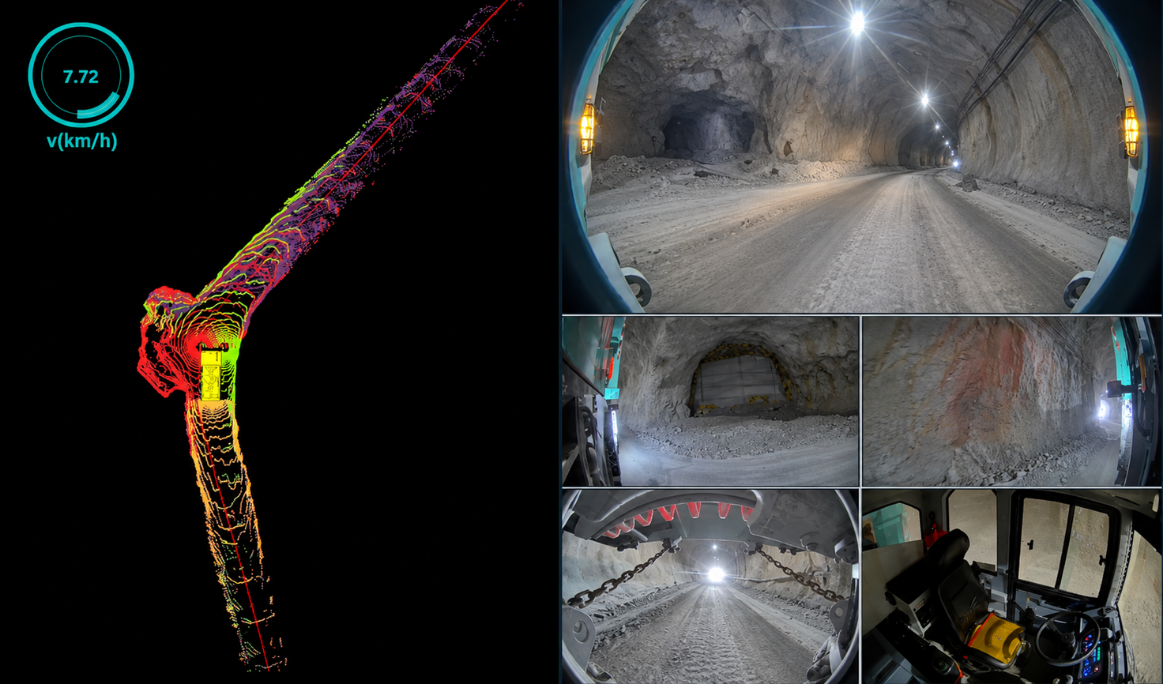
Building on proven GNSS-denied capabilities, EACON has validated autonomous operation through extended tunnel sections, with mining trucks now operating without completely relying on GNSS/RTK positioning, network connectivity, or HD maps.
EACON Mining Technology has completed validation of an autonomous driving capability that enables mining trucks to maintain driverless operation through extended tunnel sections where Global Navigation Satellite System (GNSS)/Real-Time Kinematic (RTK) positioning and network connectivity are temporarily unavailable.
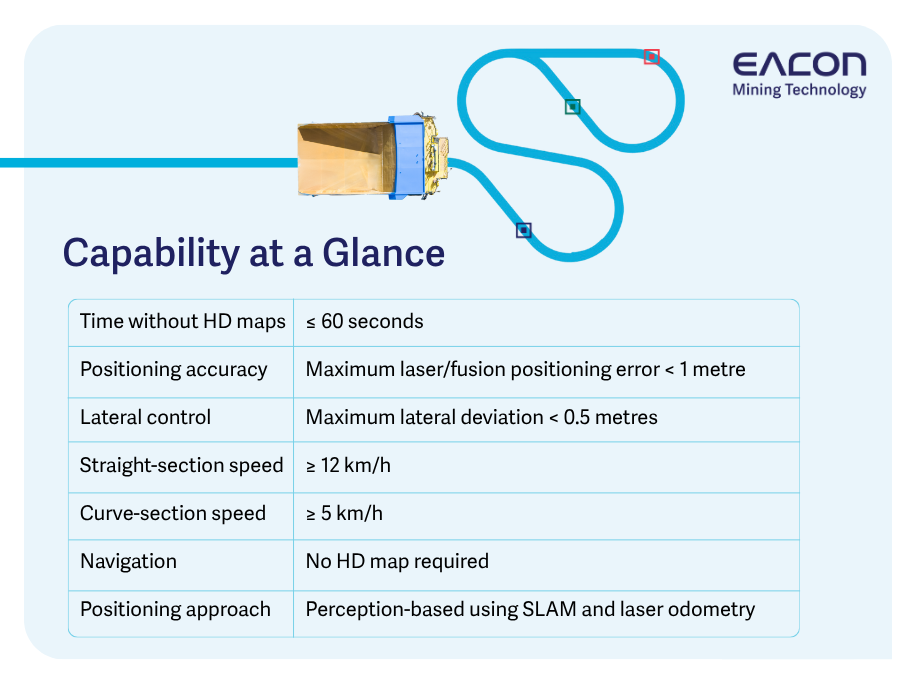
The capability supports autonomous operation without complete reliance on conventional high-definition (HD) maps for up to 60 seconds. EACON's solution uses rough navigation information, including road topology, together with a perception-based positioning solution to determine the truck's position and movement through GNSS-denied areas.
Building on EACON's previous experience operating in GNSS-denied environments, including covered crusher zones at the Fushan Quarry, the Zijinshan application further extends this capability to continuous tunnel sections more than 400 metres long, with SLAM and laser odometry supporting autonomous operation.
Maintaining Autonomy Where GNSS is Unavailable
When an autonomous truck enters a tunnel, losing access to GNSS/RTK positioning and network connectivity creates an immediate challenge: the truck still needs to know where it is, remain safely within the tunnel boundaries and maintain an appropriate operating speed.
EACON's capability addresses this by using perception-based positioning, including simultaneous localisation and mapping (SLAM) and laser odometry, to support autonomous driving where conventional positioning signals and network connectivity are unavailable.
The confined tunnel environment makes safe operation particularly critical. As GNSS/RTK signals are unavailable inside the tunnel, the system cannot obtain a precise absolute positioning reference. Instead, it uses a relative positioning approach, with the tunnel boundaries detected in real time serving as the reference. Local path planning further constrains the vehicle’s trajectory to ensure that the planned path does not collide with the tunnel boundaries.
In addition to maintaining relative positioning accuracy, this function also allows trucks to continue moving at a practical speed. For applicable tunnels, it supports stable driving speeds of at least 12 km/h on straight sections and at least 5 km/h through curves.
Together, these measures show how the system addresses the three key requirements of tunnel operation: knowing where the truck is, keeping it on its planned path, and maintaining its movement through the tunnel when conventional positioning is unavailable.
In Operation at Zijinshan Copper-Gold Mine
At the Zijinshan Copper-Gold Mine, mining trucks with EACON's autonomous solution are operating through mountain tunnels more than 400 metres long, with widths of up to seven metres and curve radii as tight as 27 metres.
Within these tunnels, the trucks typically operate at approximately 12–15 km/h across most sections and around 6 km/h through narrow exit lanes — matching or exceeding the operating speeds of manned trucks under the same conditions.
Charles Yang, Senior Solutions Specialist at EACON, commented:
"The Zijinshan application shows why this capability matters in practice. Autonomous haulage needs to perform consistently throughout the haul cycle, including through sections where conventional positioning and connectivity are unavailable."
By combining rough navigation information with a perception-based positioning solution, EACON's autonomous haulage technology can maintain operation through applicable tunnels without relying on GNSS/RTK positioning, network connectivity or conventional HD maps.
Following successful validation, this capability expands the range of environments where EACON's autonomous haulage technology can operate, including continuous tunnel sections of more than 400 metres long.
Share this page