

EACON and Tonly Advance Purpose-Built, Cabless, Autonomous Haulage with EQ100E
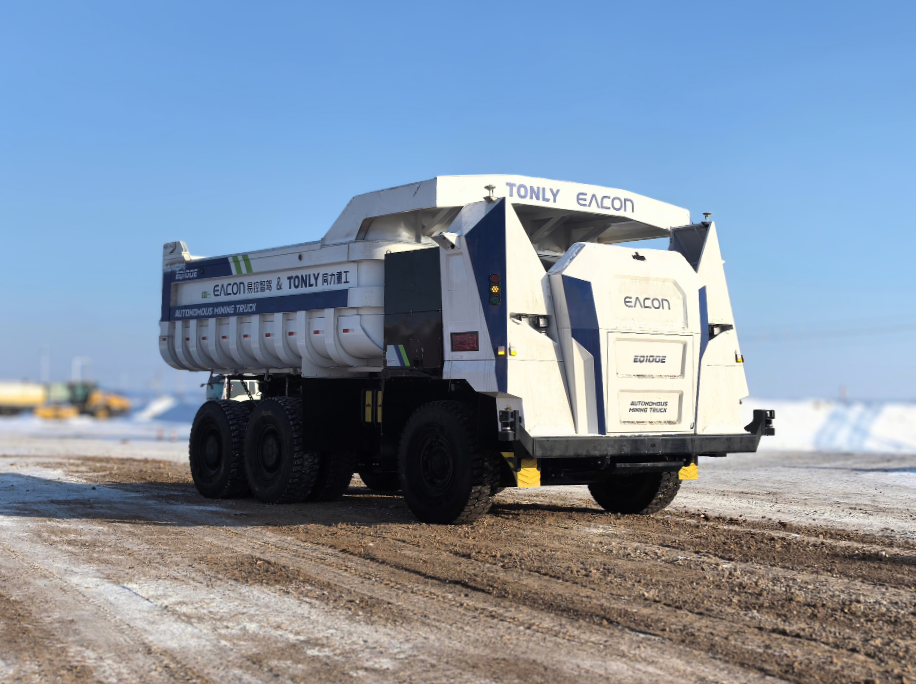
What happens when a mining truck is designed for autonomous operation from the outset, rather than adapted for it later?
EACON and Tonly are putting that approach to the test with the EQ100E, a cabless, battery-electric autonomous mining truck that combines Tonly's vehicle engineering and manufacturing capabilities with EACON's autonomous solution and drive-by-wire design.
Following its unveiling at the 21st China International Coal Mining Expo in October 2025, the first EQ100E arrived at Hongshaquan No. 2 Coal Mine in northwest China in late January 2026. There, it successfully completed full-cycle testing in a live mine environment. A second unit was deployed at another mine site in May, extending field testing across different operating conditions.
While removing the cab is the most visible change, the EQ100E explores a broader shift in autonomous haulage: designing the vehicle architecture, control systems and autonomous technology around driverless operation from the beginning.
Purpose-Built for Autonomous Operation
Much of the mining industry's transition to autonomous haulage has involved integrating autonomous technology into vehicles originally designed for human operation.
The EQ100E takes a different approach.
Its electrical and electronic architecture (EEA), distributed drive system, and vehicle control systems have been developed around the requirements of autonomous operation. This approach extends from perception and vehicle control through to propulsion and braking, bringing the autonomous driving system and underlying vehicle architecture closer together.
For EACON, the EQ100E provides a platform to test how this deeper integration performs in real mining operations and under changing road and environmental conditions.
More Precise Control in Changing Conditions
One of the EQ100E's key differences is its distributed drive architecture.
Four independently controlled wheel-side motors allow torque and rotational speed to be managed at individual wheels, providing greater flexibility in how the vehicle responds to changing ground conditions.
When the truck encounters uneven terrain or sections with different levels of adhesion, such as wet or muddy roads, the system can recognise changes in road adhesion and redistribute torque in real time. This helps correct vehicle deviation and suppress wheel slip, supporting a stable driving trajectory.
During demonstrations, the architecture also enabled 360º in-place steering through independent wheel control. In narrow areas such as loading and dumping locations, this gives the EQ100E greater manoeuvrability within a smaller operating area.
Rather than simply removing the driver from a conventional vehicle, capabilities such as these demonstrate how the physical movement of the truck itself can be reconsidered when autonomous operation is incorporated into its design.
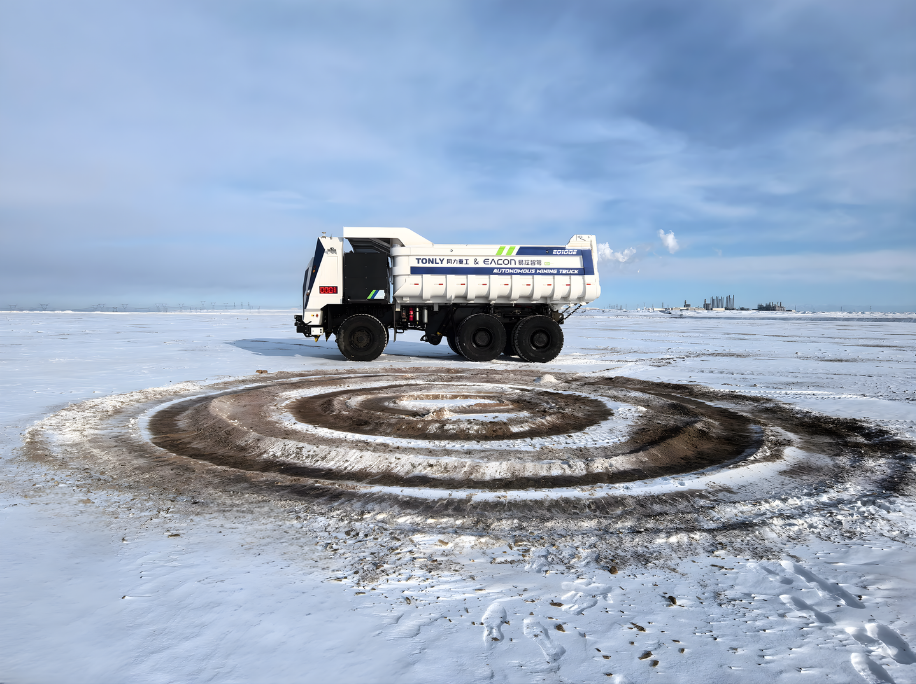
Tire Tracks From a 360º In-Place Turn Completed During Demonstrations
Building Redundancy into Driverless Operation
EACON’s autonomous haulage solution incorporates safety redundancy, fault response and diagnostic capabilities across the vehicle and autonomy system. The EQ100E extends this approach at the vehicle level, with several critical systems designed with redundancy to support autonomous operation.
Its full-hydraulic braking system integrates service, parking and emergency braking functions, as well as loading braking and ABS. In the event of a single-circuit failure, the system can retain independent braking capability.
Critical sensors and controllers are also supported by redundant power supplies, alongside remote restart and fault diagnosis capabilities.
Together, these features support a safety architecture designed for autonomous operation without relying on an onboard driver to respond to a fault.
Putting the Complete System to the Test
The EQ100E's field testing is putting these capabilities to the test in live mining operations across different site conditions.
Testing of the first EQ100E began at CHN Energy's Hongshaquan No. 2 Coal Mine in January 2026. The truck completed full-cycle testing under both loaded and unloaded conditions on uneven roads and in low-adhesion conditions, demonstrating its power performance and handling stability under actual operating conditions.
During loaded reversing, the EQ100E operated with a 100-tonne load at speeds of up to 20 km/h, and during testing, speeds of 15 km/h were achieved in loaded uphill haulage at an 8% gradient.
A second EQ100E joined the field programme in May 2026 and is now being deployed across adjacent mining sites as needed, supporting operations and extending testing across different site conditions.
Both EQ100Es are operating routinely in mixed fleets alongside other mining vehicles, with each unit now having driven over 10,000 kilometres autonomously.
This has provided an opportunity to evaluate not only individual vehicle capabilities, but also how the EQ100E's autonomous driving, vehicle control, propulsion, steering, and braking systems work together in mining operations.
A Foundation for Future Deployment
The EQ100E also demonstrates how EACON works with mining truck OEMs at the vehicle level.
Guanghan Li, Head of Truck Engineering at EACON, commented:
“Our in-house truck engineering capabilities give us a deeper understanding of the vehicle itself, which is essential when integrating autonomy at the equipment level. At the same time, we work closely with OEMs to combine our autonomous driving and vehicle-level engineering expertise with their vehicle engineering and manufacturing capabilities. This collaborative approach allows us to design and adapt vehicle-level solutions to better support autonomous operation.”
The EQ100E is one example of EACON's broader approach to working with OEMs, combining autonomous driving and drive-by-wire design expertise with OEM vehicle engineering and manufacturing capabilities.
Alongside other OEM collaborations and purpose-built autonomous platforms, including the 150-tonne cabless autonomous AT150, the EQ100E demonstrates how closer integration between autonomous technology providers and equipment manufacturers can support the development and deployment of autonomous haulage equipment.
Share this page