

From One Truck to Thousands: The Global Rise of Autonomous Mining
The mining industry has a long history of adopting transformative innovations, with autonomous haulage standing out as one of the most significant. Over the past two decades, driverless haul trucks have moved from proving-ground experiments to mainstream operations across the world. This evolution of safety, efficiency, and flexibility demonstrates how autonomous solutions are redefining the future of mining.
Where It All Began
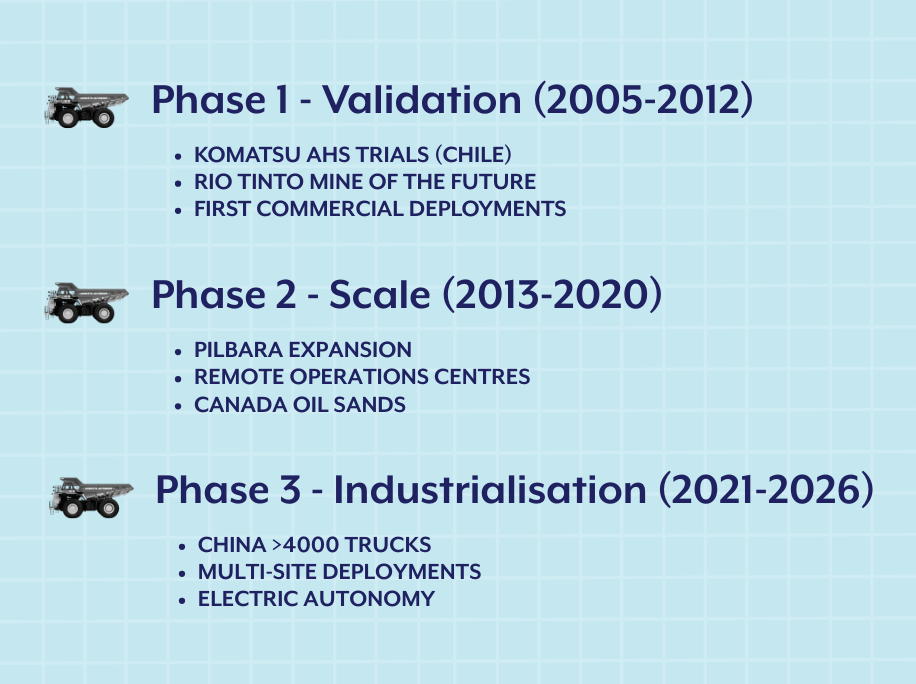
2005
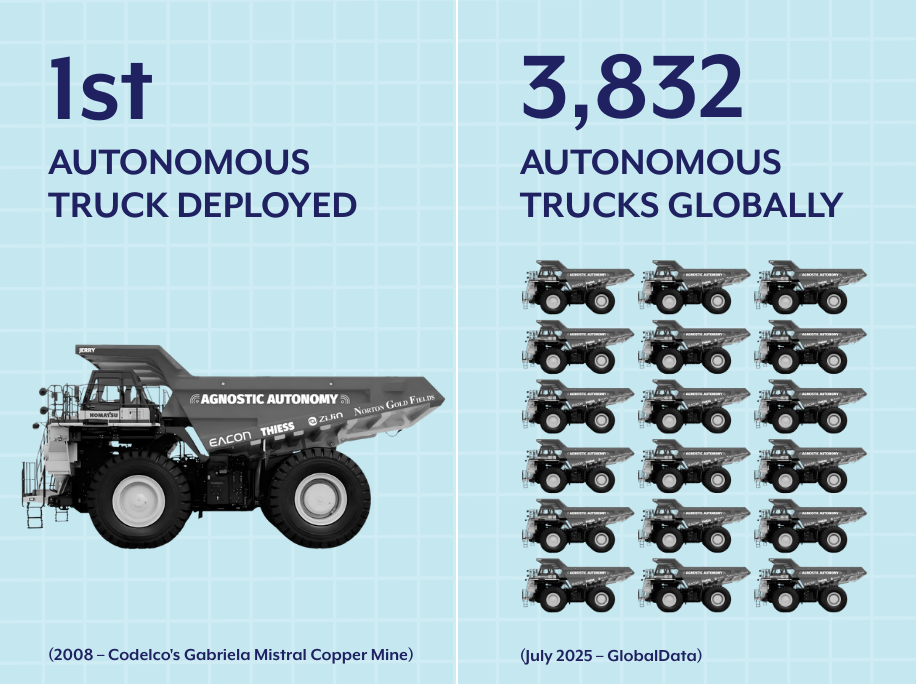
The journey toward fully autonomous mining began in 2005, when Komatsu commenced trials of its Autonomous Haulage System (AHS) at Codelco’s copper mine in Chile. These early experiments laid the foundation for what would become one of the most significant technological shifts in modern mining.
2008
Rio Tinto launched its Mine of the Future program as a long-term vision to transform mining through automation, digital technology and data integration. The initiative aimed to improve safety, efficiency and sustainability by introducing autonomous haulage, remote operations centres and advanced monitoring systems. It positioned Rio Tinto as a global leader in mining innovation and automation.
2011
In 2011, Rio Tinto and Komatsu signed a landmark agreement to deploy 150 autonomous trucks in Western Australia, marking the world’s first large-scale commercial rollout of AHS technology. This partnership was pivotal in establishing the Pilbara as a global hub of mining innovation.
2012
Rio Tinto took a major step towards large-scale automation in 2012 with the introduction of its first driverless haul trucks at the Yandicoogina mine in the Pilbara. The project marked the company’s initial move from pilot trials to real-world production, demonstrating that autonomous haulage could safely and efficiently operate in an active mining environment. Early results showed improved cycle consistency, reduced idle time, and lower operating costs, paving the way for further expansion. Fortescue followed suit with the rollout of Autonomous Haulage System (AHS) technology, beginning the conversion of its Caterpillar truck fleet across the Solomon and Chichester Hubs.
2013
Building on the success at Yandicoogina, Rio Tinto extended autonomous haulage to its Nammuldi mine in 2013. The deployment further validated the technology’s scalability, proving that autonomy could integrate across multiple mine sites. The Nammuldi operation became a model for Rio Tinto’s broader automation strategy in the Pilbara, laying the groundwork for one of the world’s largest autonomous mining fleets.
Hitachi Construction Machinery commenced validation of its Autonomous Haulage System (AHS) at an Australian test site in 2013, confirming the system’s capability to perform sequential mining operations including loading, hauling, and dumping using autonomous dump trucks.
2015
By 2015, these were remotely controlled from Rio Tinto’s Operations Centre near Perth Airport, over 1,200 kilometres away — marking the world’s first fully autonomous mine operated entirely from a city office.
2017
In 2017, BHP completed the rollout of its first fully autonomous haul truck fleet at the Jimblebar mine. This implementation reduced exposure to driving-related hazards, directly increasing worker safety. It also improved productivity by optimising truck operation and created opportunities for workforce reskilling and new digital roles, illustrating the multifaceted impact of automation.
2018
In 2018, Hitachi joined forces with Whitehaven Coal to trial an autonomous haulage solution that combined Hitachi Construction Machinery’s Smart Mining Truck (featuring advanced vehicle stabilisation controls, robotics, AC motor and drive control technologies), with the fleet management capabilities of Hitachi’s Wenco International Mining Systems subsidiary. 2018 also saw EACON Mining Technology, an autonomous haulage solutions provider, founded in Beijing.
2019
By 2019, Fortescue Metals Group entered the autonomy race, deploying Cat 789D trucks fitted with Caterpillar’s Autonomous Haulage System (AHS) at its Cloudbreak mine in the Pilbara. This marked Fortescue’s formal entry into large-scale autonomy and signalled the rapid mainstreaming of driverless technology across Australia’s iron ore sector.
That same year, Rio Tinto and Komatsu celebrated their long-standing partnership with the delivery of the 300th AHS truck to the Pilbara, maintaining one of the world’s largest single-owner autonomous fleets.
BHP Mitsubishi Alliance (BMA) announced a major modernisation plan to retrofit up to 86 Komatsu 930E haul trucks with autonomous technology at its Goonyella mine. The initiative marked the start of a multi-year transformation involving technology upgrades, operational changes and workforce adaptation.
Over in China, EACON Mining Technology began their first autonomous haulage tests in the field. After their first prototype truck reached the test site in May, they quickly scaled up to a complete autonomous fleet by August.
Throughout the 2010's, autonomy steadily expanded. Komatsu and Caterpillar extended deployments into Canada’s oil sands and Chile’s copper belt. At the same time, BHP, Fortescue, and Rio Tinto continued to scale up fleets across the Pilbara.
2020
BHP Mitsubishi Alliance (BMA) commenced autonomous operations at Goonyella with a small fleet of retrofitted Komatsu 930E haul trucks. The trucks were progressively integrated into daily operations as the site adapted to the technical and operational challenges of retrofitting an active mine.
Across the mining industry, autonomous haulage had proven itself a reliable and effective way to improve both safety and productivity. By removing operators from high-risk environments, it significantly reduced heavy-vehicle interactions and on-site incidents. At the same time, consistent, data-driven truck movements improved fleet utilisation, optimised haul cycles, and enabled more precise mine planning. For many miners, the introduction of autonomy marked a turning point towards safer, more predictable, and more efficient operations.
EACON Mining Technology launched an autonomous haulage project at the South Open-Pit Mine in northwest China, starting with a fleet of nearly 40 factory-fitted trucks operating under real mine conditions.
2021
In 2021, Roy Hill advanced its automation program through a partnership with Epiroc and ASI Mining to convert its haul truck fleet to autonomous operation. The collaboration aimed to deliver an interoperable solution for Roy Hill’s mixed fleet, capable of expanding across multiple vehicle types and integrating with existing mine systems. Epiroc and ASI worked alongside Roy Hill and its partners, Hitachi and Wenco, to convert the trucks and integrate the Wenco fleet management system.
The project began with testing and verification of up to 8 trucks before scaling to full fleet conversion. Epiroc and ASI Mining later received an order to automate 18 Hitachi EH4000 haul trucks, increasing Roy Hill’s fleet to 96 autonomous-ready vehicles.
2022
By 2022, BHP Mitsubishi Alliance (BMA) had successfully expanded autonomous operations at Goonyella, integrating a large fleet of autonomous haul trucks and establishing the site as BHP’s most advanced autonomous mining operation in Queensland. In the same year, BHP also commenced the South Flank Autonomous Haulage Project in Western Australia, initiating the automation of 41 Komatsu haul trucks, with completion scheduled within 18 months.
Around the same time, Caterpillar advanced its electrification strategy, completing development of the first battery-electric 793 prototype with support from major mining partners through its Early Learner program. Participating companies, including BHP, Freeport-McMoRan, Newmont Corporation, Rio Tinto and Teck Resources, signed definitive agreements to collaborate on testing and deploying the next generation of zero-emission haulage technology.
Meanwhile in China, the first Yutong YTK90E all-electric autonomous mining trucks were deployed. Developed in collaboration between Yutong Mining Equipment and EACON Mining Technology, the trucks were deployed at Shandong Honghe Baili Mining’s limestone operation. As the world's first fully electric autonomous mine, the project marked a major step forward in the electrification of autonomous haulage.
2023
By 2023, Epiroc, in collaboration with its partner ASI Mining, reported that it was converting Roy Hill's 96-truck fleet to become one of the world's largest single-site autonomous haulage operations, and the first to feature four different truck models from two original equipment manufacturers. During the same period, EACON continued expanding operations at the South Pit in northwest China with the addition of 100 new hybrid electric autonomous mining trucks. The site had already been operating 40 autonomous trucks, bringing the total fleet to 140 working seamlessly at a single mine. With this expansion, the South Pit became the largest single-site autonomous haulage operation in the world, reinforcing EACON’s position as a growing global provider of autonomous haulage systems.
A Global Fleet Achieved
Global Fleet
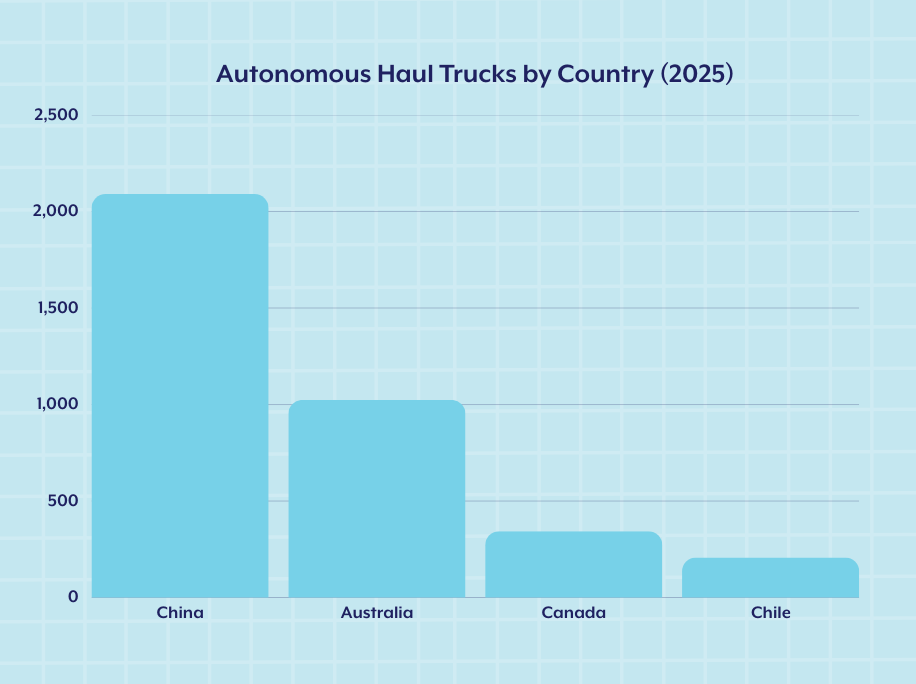
By mid-2024, the global autonomous haul truck fleet had reached 2,080 units, with Australia accounting for 927 trucks. Around the same period, EACON passed the milestone of 1,000 autonomous haul trucks equipped with its AHS. Between July 2024 and July 2025, the global number accelerated sharply, rising to 3,832 autonomous haul trucksoperating across surface mines worldwide – including both fully autonomous units and trucks equipped with autonomous-ready systems. This represented an 84% year-on-year increase, with China emerging as the largest single national marketat 2,090 trucks, followed by Australia, Canada and Chile.
Industry reports from China indicate that autonomous haul truck deployments in China have continued growing rapidly, with total autonomous mining truck units in the country reportedly surpassing 4,000 by the end of 2025.
According to GlobalData’s Mining Intelligence Centre, CHN ENERGY Investment Group operates the highest number of autonomous haul trucks globally among energy and resource companies, followed by Guanghui Energy, BHP and Rio Tinto. From a manufacturer perspective, Caterpillar and Komatsu account for the largest share of autonomous-capable haul trucks deployed worldwide, reflecting the scale of their proprietary autonomous haulage platforms.
Unlike OEM-specific platforms, EACON provides a fully OEM-agnostic autonomous haulage system capable of integrating with any haul truck regardless of brand, model or age. This flexibility, combined with its deployment scale across multiple manufacturers and commodities, positions EACON as the world’s largest independent provider of autonomous haulage systems for mining operations.
China
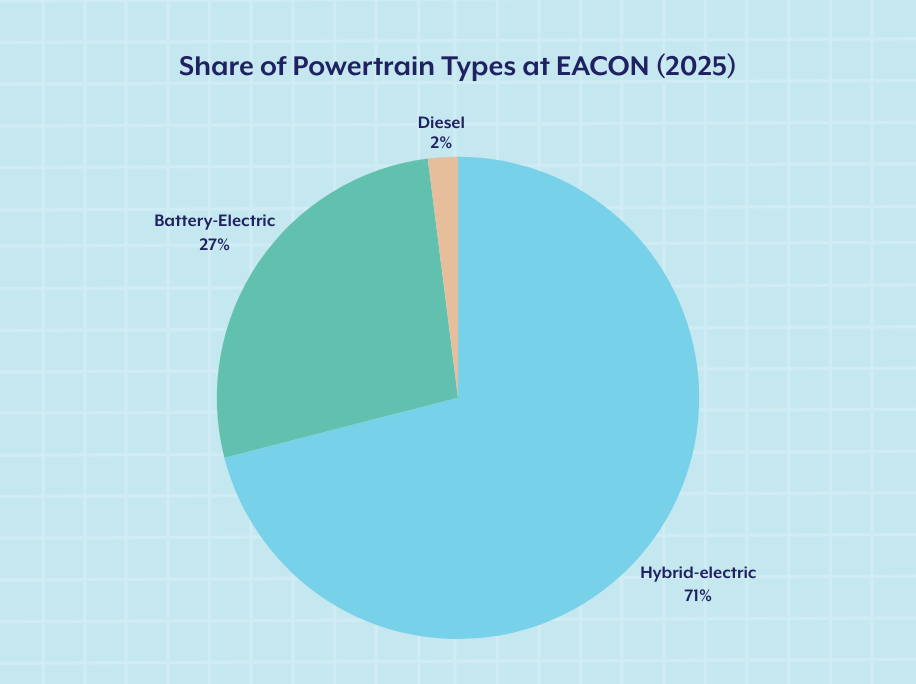
China has rapidly become the global centre of large-scale autonomy deployment. In October 2023, the South Open-Pit Coal Mine became the first single site in the world to surpass 200 autonomous trucks. Managed by EACON, the fleet included 172 hybrid units, representing a major leap forward in large-scale automation and low-emission mining. In June 2025, EACON commenced deployment of 500 autonomous haul trucks at Guanghui Energy’s Baishihu Open-Pit Coal Mine, marking the largest single-site autonomous haulage project announced to date. By September 2025, EACON had exceeded 2,000 autonomous truck deployments. As of February 2026, that figure has continued to grow significantly, with EACON’s deployments spanning more than 25 sites across China. Approximately 80% of the fleet consists of hybrid-diesel trucks and 20% battery-electric units, operating across coal, aggregates, iron ore, copper, gold and zinc mines.
With China now surpassing 4,000 autonomous trucks nationwide, EACON remains the dominant autonomy provider in the world’s largest autonomy market, reinforcing its position as the global leader in autonomous haulage technology.
North America
In North America's quarry sector, Komatsu has broken new ground through a partnership with Pronto, a developer of off-road autonomy systems. In 2025, Komatsu and Pronto unveiled the Komatsu Smart Quarry Autonomous System, integrating Pronto’s autonomy stack into haul trucks operating within Komatsu’s Smart Quarry platform. This OEM-agnostic system enables quarry operators to retrofit existing trucks or purchase new autonomy-enabled units, allowing 24/7 operation with reduced human intervention. This marks a significant shift by bringing autonomous haulage technology, once reserved for mega-mines, into mid-tier and aggregate operations across North America.
Canada
Canada’s surface-mining sector is rapidly embracing autonomous haulage systems (AHS) as part of its move to improve safety and efficiency. Imperial Oil has completed the conversion of its entire heavy-haul truck fleet at the Kearl Oil Sands Mine in Alberta to fully autonomous operation. 81 trucks now operate without human drivers, making it one of the largest autonomous mining fleets globally.
Suncor Energy has also expanded its autonomous fleet at the Millennium Mine, progressing from phased rollouts which reached 91 AHTs in 2024 toward large-scale operational deployment.
Canada’s adoption reflects a transition from pilot programs to full production fleets. Cost pressures, remote terrain and long-life assets make autonomy particularly attractive in oil sands operations, placing Canada among the top countries globally by autonomous haul truck population.
South America
In South America, autonomous haulage is gaining strong momentum as global OEMs expand their presence across the region’s major mining hubs. Caterpillar’s Cat Command for Haul Trucks is now operating at multiple South American sites as part of its global network of 17 autonomous mines, while Komatsu has achieved major milestones with deployments at Glencore’s Lomas Bayas Copper Mine in Chile and plans to introduce 37 autonomous 930E trucks at Vale’s Carajás Mine in Brazil. These projects mark a shift from small-scale pilots to large-scale operational fleets, supported by growing regional investment in digital infrastructure and skilled workforce training. Together, Caterpillar and Komatsu are establishing South America as a core pillar in the global autonomous haulage landscape, transforming how copper, iron ore and lithium mines operate across Chile, Peru and Brazil.
Australia
Australia continues to contribute to the global haulage automation wave, with strong momentum across both autonomy and electrification. Regulatory frameworks in Western Australia, New South Wales and Queensland have paved the way for widespread adoption of autonomous systems, giving the country a head-start in large-scale deployment.
Major miners continue expanding their autonomous operations. Fortescue Metals Group has progressively increased the scale of its autonomous haulage fleet across multiple sites, while BHP and Rio Tinto continue to extend autonomous haulage across their iron ore operations in Western Australia. In parallel, these companies are integrating autonomy with next-generation battery-electric haul trucks, signalling the convergence of automation and decarbonisation strategies rather than treating them as separate initiatives.
Australia is also emerging as a testbed for more flexible autonomy models. EACON Mining Technology has launched an OEM-agnostic autonomous haulage trial in Western Australia in partnership with Thiess and Norton Gold Fields, retrofitting a Komatsu HD1500 truck with its AHS platform. This project represents a shift from proprietary OEM-controlled ecosystems toward interoperable autonomy solutions capable of operating across mixed fleets.
All in all, Australia’s haulage automation story is maturing into one of scale, electrification and strategic flexibility. It’s no longer just about first movers, it’s about building sustainable, future-proof mining fleets that combine autonomy, zero-emissions powertrains and adaptable technology platforms.
Unlocking a Collaborative Environment
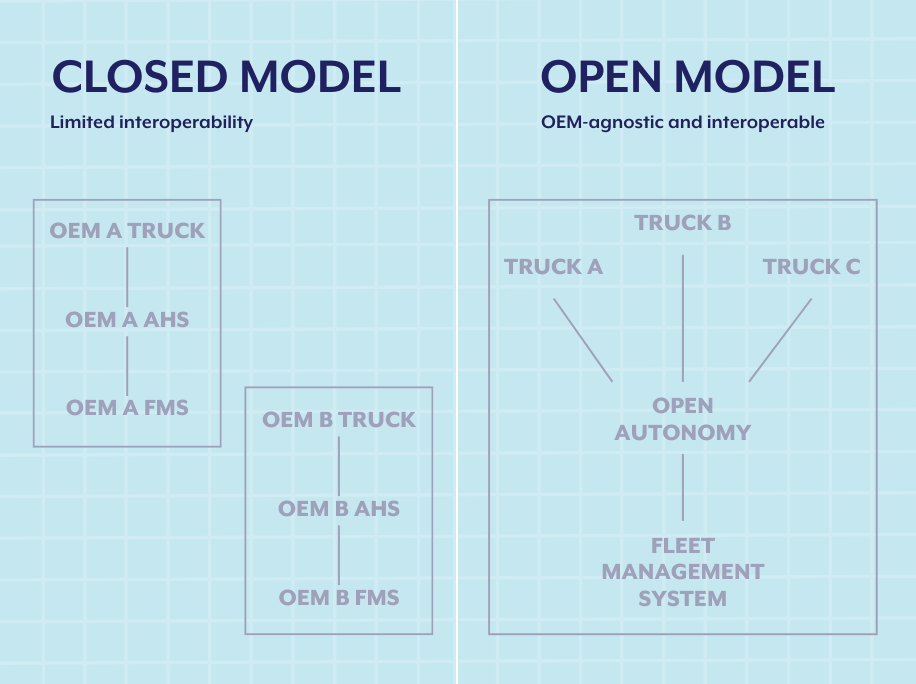
With the success of autonomous haulage now proven, the next challenge is scaling it across diverse fleets. Mine operators increasingly demand interoperability: the ability for trucks from different OEMs to work together seamlessly and for fleets to integrate autonomy with emerging low-emission technologies.
This is where 'open autonomy' comes in. Open autonomy provides a universal interface that allows any Fleet Management System to connect with any autonomous platform. It breaks down proprietary barriers and fosters genuine collaboration between OEMs, autonomy providers, and mine operators, creating a more connected, flexible, and sustainable mining ecosystem.
EACON is redefining what this means in practice. Its agnostic autonomy solution delivers true interoperability at scale through the ORCASTRA® platform, a vendor neutral system that allows any truck, new or existing, hybrid or battery electric, to operate autonomously through a universal drive by wire interface. This approach enables mine operators to integrate autonomy across mixed fleets and existing assets while maintaining full flexibility and control. By promoting interoperability, open or agnostic autonomy fosters a collaborative environment where OEMs, technology developers, and mining companies can mix and match solutions, accelerating both innovation and large-scale deployment. Wenco, part of Hitachi, has taken this approach, highlighting how standardised protocols between Fleet Management Systems and Autonomous Haulage Systems create a single source of truth for equipment locations and a consistent framework for truck dispatch and safety management. These open standards are paving the way for a future where any haul truck, regardless of brand or model, can be retrofitted for autonomy and operate seamlessly within any compliant control environment.
Electric Autonomy at Scale
The next phase in the evolution of autonomous haulage is the convergence of autonomy and electrification, often referred to as “electric autonomy.” Across China’s mining sector, large-scale deployments of battery-electric haul trucks from OEMs such as XCMG, SANY and Yutong are now operating with advanced autonomy platforms, demonstrating that zero-emission fleets can function at production scale rather than in pilot environments.
At the Yimin Open-Pit Coal Mine in Inner Mongolia, 100-tonne battery-electric haul trucks manufactured by XCMG are operating autonomously in sustained production conditions, including extreme temperatures as low as −40°C. The fleet is planned to expand toward 300 trucks, reflecting how electric platforms are now being deployed within large autonomous haulage systems rather than remaining in pilot phases.EACON is also advancing large-scale battery-electric autonomy across China’s mining sector. The company has rolled out a series of battery-electric autonomous haulage deployments, which now account for around a quarter of its 2,000-strong fleet. In 2024, EACON expanded its electric portfolio through two quarry projects deploying 29 EY70E electric trucks at Pingyin and Shuichang, followed by the delivery of battery-powered XCMG EX80 units at the Zijinshan Copper-Gold Mine. Later that year, the company introduced 52 battery-electric vehicles at the Hongshaquan 2 Open Pit Coal Mine, supporting both overburden and coal haulage through a centralised intelligent control system. EACON also delivered its first electric autonomous iron ore project at Baowu’s Xichang mining operation, automating six SANY 70-tonne trucks using its ORCASTRA® autonomy platform. Most recently, EACON commissioned 16 battery-electric vehicles at Shougang Group’s Daishihe Iron Ore Mine, developed in collaboration with Yutong. This initiative established one of China’s most advanced autonomous, zero-emission haulage fleets and demonstrated full-cycle operations in just over one month. Collectively, EACON's projects demonstrate that electric autonomy has moved beyond pilot-scale trials and is now operating at commercial scale, accelerating the transition to low-carbon, intelligent mining.
Looking Ahead
From just a handful of trial trucks in Chile in 2005 to thousands of autonomous vehicles across the globe, haulage automation in mining has come a long way. The next phase will not be about proving the technology; it will be about scaling it, ensuring interoperability, and integrating it with net-zero commitments.At this critical juncture, collaboration will define the path forward. Open standards, V2V communication, and retrofit autonomy are paving the way for fleets of any brand, model, or energy source to operate together. EACON is committed to advancing this collaborative future, working with OEMs, technology partners, and mining companies to make autonomy accessible, adaptable, and sustainable for the industry as a whole.
Share this page