

Introduction to Autonomous Haulage Systems (AHS)
Mining is undergoing a significant transformation as operators worldwide increase their investment in automation to address safety risks, rising operating costs and decarbonisation goals. Autonomous haulage systems are central to this shift, supporting continuous 24/7 operations with stronger safety measures, lower operating costs, and improved productivity with more accurate data driven decision making.
Autonomous haulage is being expanded globally through two parallel pathways: OEM-led systems such as Caterpillar MineStar and Komatsu FrontRunner AHS, as well as third-party autonomy platforms like EACON ORCASTRA and Epiroc Open Open Automation that operate independently of truck manufacturers. Miners of all sizes are now exploring autonomy as a practical way to improve efficiency and sustainability while maintaining existing operational infrastructure without disrupting existing operations.
What Does AHS Mean?
Autonomous Haulage Systems (AHS) refer to integrated mining systems that enable haul trucks to operate without onboard drivers, using coordinated fleet intelligence, high-precision positioning, vehicle-to-everything (V2X) communications, and real-time decision-making software.
Rather than functioning as isolated autonomous vehicles, AHS orchestrates entire haulage fleets within defined operational zones, delivering safer, more consistent, and highly efficient material movement at scale.
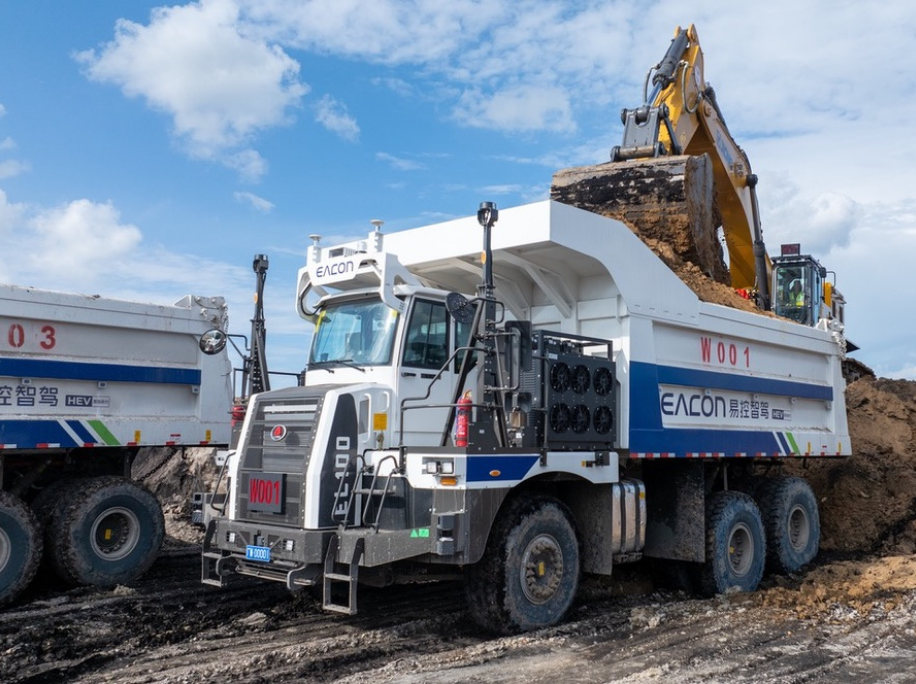
Key Benefits of AHS
Safety Improvement: Removing drivers from hazardous zones drastically reduces fatigue-related accidents and injuries.
Operational Efficiency: Autonomous trucks operate continuously, avoiding downtime from shifts or breaks, enabling more productive haulage.
Cost Savings: Komatsu’s AHS has delivered cost-per-tonne savings of up to US $0.62, translating into hundreds of millions of dollars over time.
Environmental Sustainability: By retrofitting autonomy to current models, and switching diesel vehicles to hybrid or electric, automation reduces fuel use and emissions, offering a pathway to decarbonisation.
Addressing Labour Shortages: AHS helps counter skilled-operator scarcity by automating haulage tasks.
EACON's ORCASTRA® AHS: A Case Study
We will look at EACON's ORCASTRA® AHS as an example of how these systems function. The ORCASTRA® system is an advanced autonomous haulage solution that encompasses fleet and traffic management, material tracking, fleet performance and reporting capabilities.
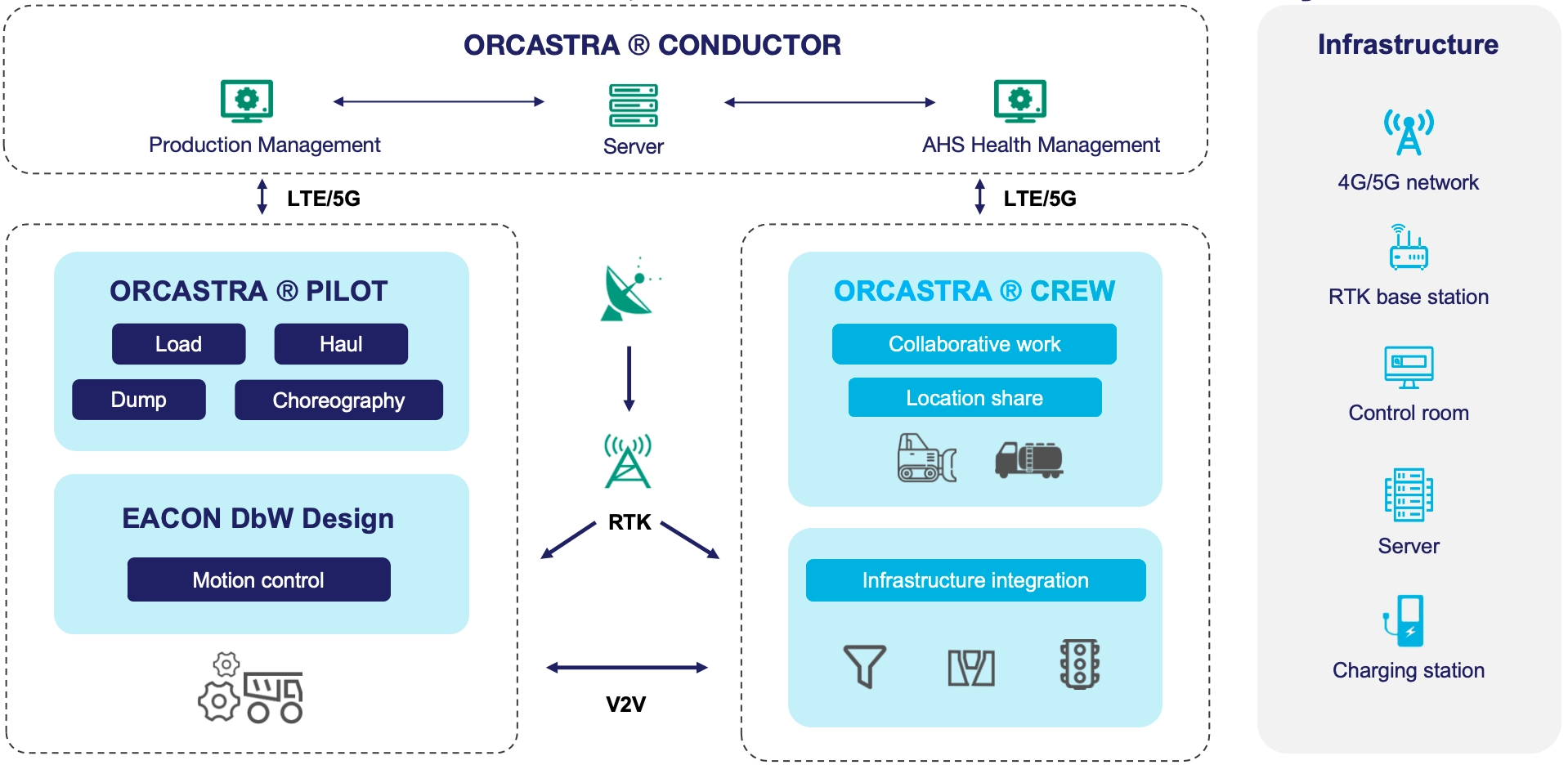
As shown in the diagram above, the ORCASTRA® AHS consists of 3 main subsystems:
CONDUCTOR - An autonomous management platform providing interfaces for operation controllers to manage production targets and AHS system health. With flexible deployment options to suit different sites, it supports both cloud-based and on-premise deployments. Key features include: real-time data-driven dispatch, production management, map management, and reporting.
PILOT - The truck's autonomous driving kit available as either an integrated option from the OEM, or as a retrofit option for your existing fleet. Using vehicle-to-vehicle (V2V) and LTE/5G connectivity, ORCASTRA® PILOT communicates with conventionally-operated vehicles, autonomous vehicles and the CONDUCTOR system to ensure seamless coordination and optimised operations.
CREW - A collaboration kit installed on all manually operated equipment entering the Autonomous Operations Zone (AOZ) to ensure safety and task coordination. It uses vehicle-to-everything (V2X) and object detection technology among load units, auxiliary equipment and trucks, to realise the efficient integration of autonomous driving with traditional operations.
The image below shows the entire AHS in action.
.png "Blog Image - Intro to AHS (4).png")
Advanced AHS Capabilities
Autonomous Navigation & Environmental Awareness: Trucks calculate optimal routes, avoid obstacles, and function within geofenced zones.
Real-Time Monitoring: Fleet platforms oversee operations, enabling remote intervention and predictive maintenance.
Precision & Efficiency: High-accuracy loading/dumping, adaptive speed control, and equipment wear reduction.
Integrated System Connectivity: Seamless communication with mine planning systems, other vehicles (V2V), and infrastructure (V2I/V2N).
Comprehensive Safety Enhancements: Include collision avoidance, emergency stops, and consistent safety behaviours.
Environmental Adaptability & Scalability: Performance in varying conditions and easy phased deployment alongside manned fleets.
Data-Driven Decision Making: Analytics inform performance improvement, maintenance forecasting, and compliance reporting.
Reduced Human Dependency & Continuous Productivity: Minimises on-site staffing needs while enabling 24/7 operations.
Levels of Automation
In mining environments, most AHS deployments today operate at level 4 automation, within controlled Autonomous Operations Zones (AOZs).
Level 0 – No Automation: The human driver is fully responsible for operating the vehicle. While some assistance features like warnings or emergency braking may exist, they don’t take over driving tasks.
Level 1 – Driver Assistance: The vehicle can assist with either steering or speed control, but not both at the same time. An example is adaptive cruise control, which adjusts speed based on traffic while the driver still steers.
Level 2 – Partial Automation: Here, the vehicle can control both speed and steering under certain conditions, but the driver must stay engaged and ready to take over at any time.
Level 3 – Conditional Automation: The vehicle can drive itself in specific conditions without human intervention. However, if the system encounters a situation it cannot handle, the driver must be ready to take control.
Level 4 – High Automation: The vehicle can fully drive itself in specific environments without human involvement. If the system reaches a situation it can’t handle, it will safely stop. However, it’s still limited to certain areas or conditions.
Level 5 – Full Automation: This is the final stage of autonomy, where the vehicle can drive itself in any environment and under any conditions. No steering wheel or pedals are needed, and no human intervention is required.
Manual vs Autonomous Haulage: A Comparative Snapshot
The differences between manual and autonomous haulage extend far beyond removing the driver from the cab. The comparison below highlights how AHS fundamentally reshapes safety, productivity, cost structure, and operational scalability across modern mining operations.
Category | Manual Haulage | Autonomous Haulage (AHS) |
Safety | Higher risk due to human error, fatigue, and exposure to hazardous environments. | Significantly improved safety by removing operators from high-risk zones and reducing incidents related to fatigue and distraction. |
Productivity | Subject to shift changes, breaks, and human variability; typically operates around 5,000–6,000 hours per year. | Continuous 24/7 operation with higher utilisation rates, achieving up to 7,500 hours per year, leading to increased productivity. |
Operational Cost | Higher labour costs due to the need for multiple operators per truck; increased fuel consumption and maintenance costs. | Lower labour requirements (e.g., less than one operator per truck); reduced fuel consumption by approximately 13%; decreased maintenance costs due to consistent operation and reduced wear and tear. |
Maintenance | Frequent maintenance due to variable driving patterns and potential for human-induced wear. | Predictive maintenance enabled by consistent operation and real-time monitoring, leading to extended equipment life and reduced downtime. |
Environmental Impact | Higher emissions and fuel consumption; less efficient use of resources. | Reduced emissions and fuel consumption; potential integration with electric vehicles for zero-emission operations. |
Capital Investment | Lower initial capital expenditure; utilises existing infrastructure and equipment. | Higher upfront investment required for technology and infrastructure; however, long-term cost savings and efficiency gains can offset initial costs. |
Scalability | Limited by availability of skilled labor and human resource management. | Highly scalable with the ability to manage larger fleets remotely; easier to expand operations without proportional increases in labor. |
Data and Analytics | Limited data collection; relies on manual reporting and observations. | Extensive data collection and real-time analytics enable continuous improvement, performance monitoring, and informed decision-making. |
Integration with Systems | Manual coordination with other systems; potential for communication delays and errors. | Seamless integration with mine planning, dispatch, and production systems; enhanced coordination and efficiency. |
Regulatory Compliance | Compliance depends on human adherence to safety protocols and procedures. | Enhanced compliance through automated adherence to safety standards and protocols; easier to monitor and document compliance. |
Stakeholder Roles in AHS Adoption
Stakeholder | Responsibilities |
Mine Owners | Mine owners have a license to mine a particular area. They ultimately control the mine and may or may not be the ones executing the mining operations. In relation to AHS, mine owners, if operating the mine as an "owner operator", will carry the staffing and execution obligations similar to mine operators in addition to the responsibilities that fall under the mine owner banner. |
Mine Operators | Often the mine operator is not the mine owner. These contract based mining services companies run the mine on behalf of the mine owner. Their role can be varied but generally at the core is an agreement to move material from source to destination. As part of this and in relation to AHS operated mines, the mine operator will provide vehicles and operational staff to operate the AHS system, ensure road conditions are optimally maintained for continuous AHS operation and be responsible for site safety and execution. |
Technology Providers | Technology providers generally provide AHS hardware and knowledge to facilitate mine transitions to autonomous mining. This can include supply of factory-ready autonomous trucks, retrofit of existing trucks, supply and support of autonomous technology, assistance with change and risk management, provision of training functions and documentation, system updates, and ongoing technical support. |
Regulatory Bodies | State based regulatory mining bodies such as the Department of Mines, Petroleum and Exploration (DMPE) in Western Australia or Resources Safety & Health Queensland (RSHQ), play a crucial role as a regulatory body overseeing mining and safety. When it comes to mining AHS, regulatory bodies such as DMPE and RSHQ are responsible for providing regulations to guide project implementations to encourage safe outcomes based on compliance. |
Challenges & Considerations
Key challenges to adopting mining autonomy can include:
High upfront asset costs, equipment retrofits, networks, and infrustructure
Workforce transition and community adaptation.
Technical challenges in extreme terrain/weather.
Regulatory approval processes, especially under DMPE in WA.
While these challenges are significant, they can be effectively managed through phased deployment, strong change management, and close collaboration between mine owners, operators, technology providers, and regulators.
.png "Blog Image - Intro to AHS (2).png")
Looking Ahead: The Road to Autonomous Zero-Emission Mining
Mining is entering a new era as companies look for practical paths to decarbonisation. Instead of waiting for full fleet replacements, many are retrofitting existing diesel trucks with hybrid or automation technology to cut emissions while preserving productivity. Thiess, for example, has partnered with Flanders on retrofit-based electrification initiatives, while working with EACON to advance autonomous haulage solutions.
While battery-electric and hydrogen haul trucks are the long-term goal, infrastructure and technology limitations mean widespread adoption will take time. In the meantime, retrofits offer miners immediate, scalable progress toward Net Zero.
EACON is demonstrating this in Australia, where a retrofitted Komatsu HD1500 is now undergoing autonomous trials at Norton Gold Fields, paving the way for a fully autonomous fleet.
As autonomy continues to scale across Australian mine sites, understanding flexible, retrofit-based AHS architectures will be key to achieving safe, cost-effective, and low-emission operations.
Share this page