

Training for the Unexpected: The Role of Simulations in Mining Autonomy
In mining, the most complex situations are also the rarest. Sudden rockfalls. Unexpected equipment movements. Extreme dust, rain, or fog. Unplanned human interactions. Degraded roads after heavy weather. These low-frequency, high-risk events are exactly where autonomous systems must perform at their best, yet they are also the hardest to train for. For autonomous mining technology, this creates a challenge: how do you safely compress extended periods of rare, high-risk experience into a timeframe that keeps deployment moving?
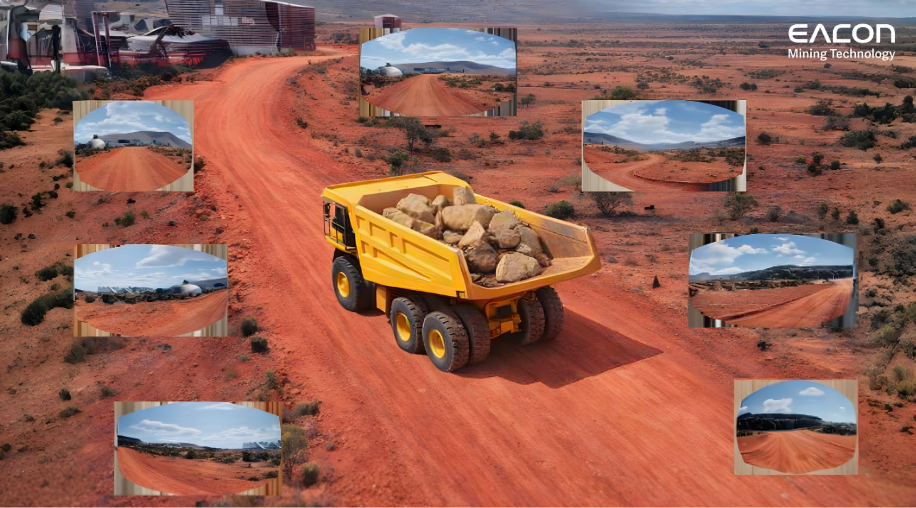
Simulated image of an autonomous mining truck navigating a haul road, with multiple camera feeds capturing its surrounding environment.
The Challenge of Low-Frequency, Long-Tail Scenarios
Autonomous driving systems continuously learn from real-world operations. Every obstacle detected, vehicle interaction, or route change contributes to a deeper understanding of the operating environment. Mining environments, however, are uniquely complex.
Each mine site operates with its own equipment configurations, traffic rules, weather patterns, and geological characteristics. While autonomous systems are designed to operate safely across these conditions, rare or unusual combinations of factors can still occur, creating scenarios that are difficult to observe frequently in real operations.
These low-frequency events — often referred to as long-tail scenarios or edge cases — can be difficult to capture in large quantities. Seasonal conditions may take months or years to repeat, extreme situations cannot always be safely recreated, and variations between sites can limit direct data reuse. As a result, relying solely on real-world exposure can slow the accumulation of diverse operational experience needed to further refine system flexibility and site-specific optimisation.
Industry Context: Lessons from Autonomous Driving
Simulation has become a cornerstone of autonomous vehicle development. Across the industry, companies rely on high-fidelity virtual environments to train AI systems, test rare scenarios, and validate performance before real-world deployment.
Dedicated simulation platforms such as Applied Intuition allow automotive and robotics companies to run thousands of virtual scenarios and automatically test autonomous systems against complex edge cases. At the same time, AI-first developers like Waabi have built large-scale simulation environments such as Waabi World to generate complex driving situations and train autonomy in closed-loop virtual environments.
Major autonomous driving companies including Waymo, Tesla, and Wayve also rely heavily on simulation to test millions of rare and complex scenarios that would be difficult to reproduce on real roads.
Mining presents its own challenges, but the same principles apply. EACON applies these approaches through its own simulation platform, enabling autonomous systems to train, evolve, and adapt within high-fidelity virtual mine environments before deployment in live operations.
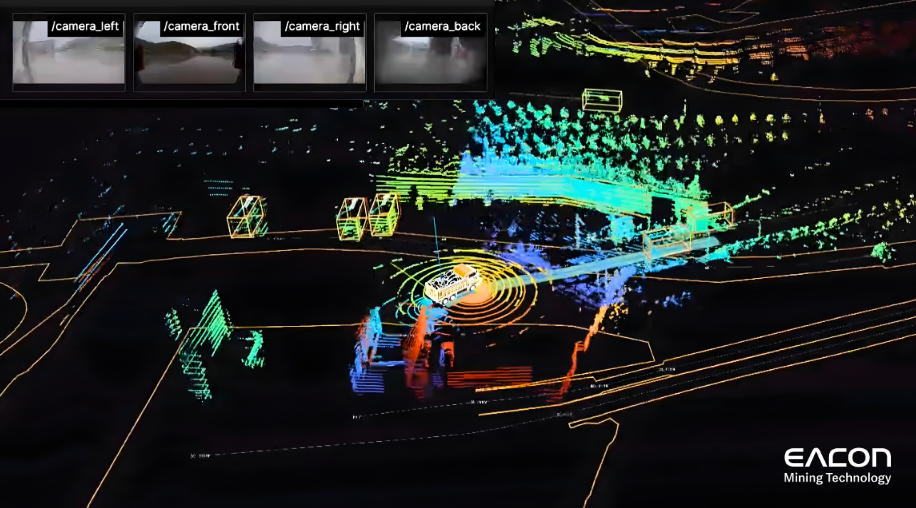
ORCASTRA® Sim reconstructs a virtual mine environment alongside real-world onboard camera views of the truck.
Using Simulations as a Virtual Training Ground
EACON's high-fidelity simulation platform, ORCASTRA® Sim, is designed to function as a "virtual training ground" for autonomous systems.
Rather than waiting for rare operational scenarios to naturally occur, ORCASTRA® Sim can generate large volumes of realistic training environments in a fraction of the time. Complex situations can be digitally reconstructed, varied, and replayed at scale, enabling engineers to explore how autonomous systems respond under a wide range of conditions. In this closed-loop simulation environment, the autonomous system continuously perceives, decides, and acts within the virtual mine just as it would in real operations.
This approach allows systems to experience thousands of operational variations before they appear in live environments, accelerating development cycles while supporting continuous improvements in adaptability and operational efficiency.
Digitally Rebuilding the Real World
ORCASTRA® Sim contains two key parts: a simulation platform and a data platform.
At the heart of the simulation platform is a high-fidelity 3D scene reconstruction engine that transforms real mine data into realistic and immersive digital environments.
Synchronised data from cameras and LiDAR sensors in our extensive real-world operations create an asset database. Using this data, we can reconstruct complete mining scenes with their terrain, road geometry, equipment movement, lighting conditions, weather behaviour, and environmental detail. A digital twin of the mine environment, these simulations behave like their physical counterparts, allowing autonomous systems to train in environments that closely mirror real-world perception.
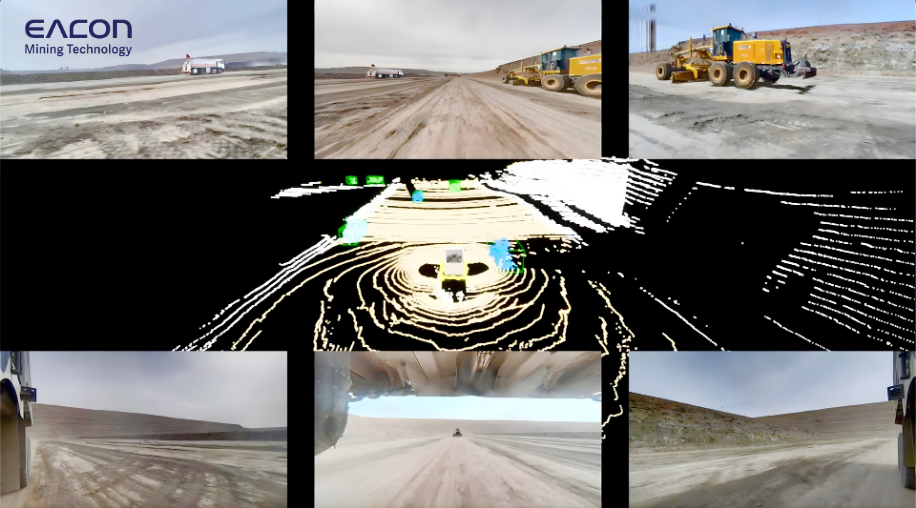
A digital twin renders terrain, haul roads, and equipment in detail, with real-world sensor data used to reconstruct the simulated environment.
To achieve this level of realism, ORCASTRA® Sim combines 3D Gaussian Splatting (3DGS) with AI-driven rendering techniques. Unlike traditional 3D reconstruction methods, which often struggle to capture dynamic environments, this approach uses both camera images and LiDAR point clouds collected from operating mining trucks to rebuild scenes with richer detail and more complete scene representation.
The result is a simulation environment that captures not only terrain and infrastructure, but also dynamic elements such as trucks, auxiliary equipment, rocks, and other operational obstacles. Lighting, shadows, and environmental effects are reconstructed to closely match real conditions, while camera and LiDAR models are calibrated to reflect the behaviour of real sensors.
This allows ORCASTRA® Sim to generate highly realistic, spatio-temporally consistent multi-sensor simulation data, giving autonomous systems the ability to train on a far wider range of mine scenarios before encountering them in live operations.
Training for the Unexpected
Once these digital environments are built, EACON’s simulation platform becomes a powerful training engine.
Rare and complex scenarios – from unexpected obstacles to extreme visibility degradation – can be rapidly generated through large-scale scenario generation, combined, and replayed at scale. Autonomous models can experience a wide range of operational variations within a compressed timeframe, allowing engineers to refine system perception and behaviour under conditions that are difficult to encounter frequently in real-world operations.
In practice, this approach has delivered measurable improvements in perception performance, particularly in challenging or low-frequency scenarios. Recognition accuracy for difficult object classes has improved significantly, helping the system distinguish more reliably between relevant objects and background features within complex mine environments.
These refinements reduce unnecessary detections and interventions, enabling smoother and more predictable vehicle behaviour while supporting simulation-to-real (Sim-to-Real) transfer, where improvements developed in virtual environments translate to real-world operations.
What This Means for Mining Operations
By enabling autonomous systems to learn faster and more thoroughly before deployment, simulation training supports:
Faster site commissioning
Improved early-stage performance
Higher operational stability
Lower disruption to production during system tuning
In real-world operations, this translates into smoother haulage cycles, improved equipment utilisation potential, and more consistent system performance from the early stages of deployment. Simulation becomes not just a development tool, but a key enabler of scalable and efficient autonomous operations.
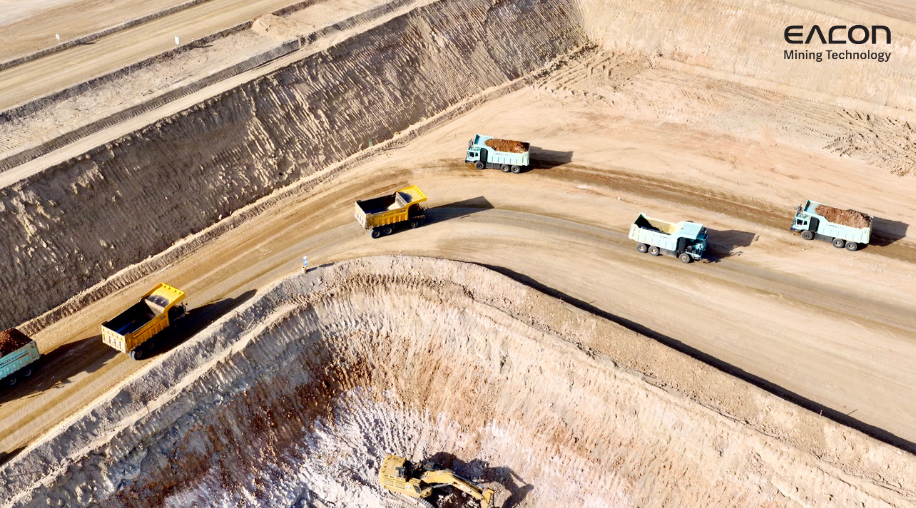
Haul trucks with EACON's autonomous system operating at a live mining deployment.
Building the Next Generation of Autonomous Mining
By combining real-world data, high-fidelity 3D reconstruction, and scalable scenario generation, EACON are enabling autonomous mining trucks to learn faster, adapt better, and operate more safely in even the most unpredictable conditions.
As autonomous mining continues to scale across increasingly complex environments, the ability to train for the unexpected will define the next generation of safety, reliability, and operational excellence.
And that is exactly where simulation makes the greatest impact.
Share this page