

Beyond the Cab: How a Cabless, Bidirectional Autonomous Truck is Rethinking Mining Haulage
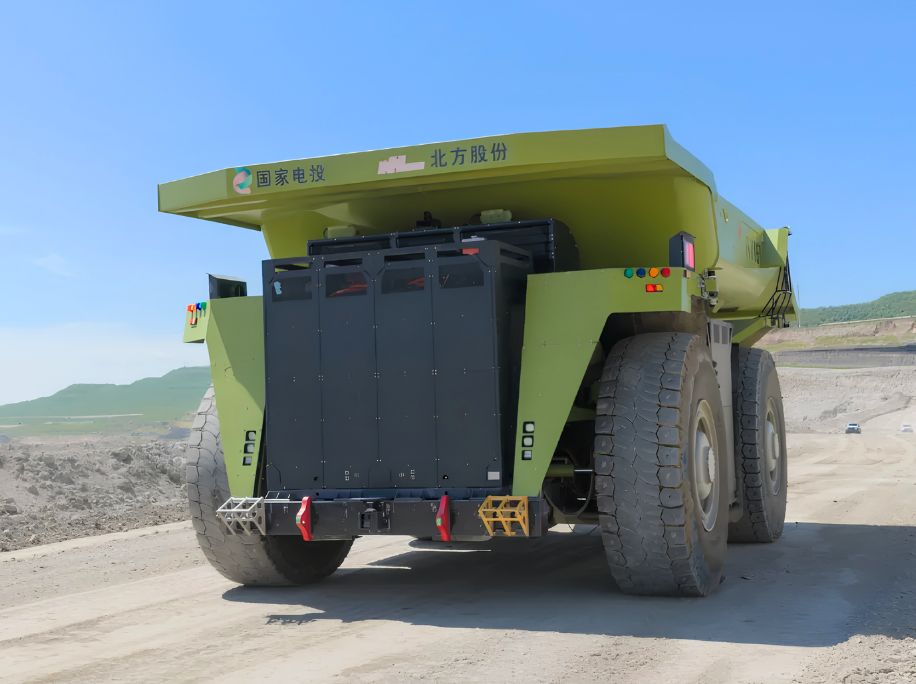
A new cabless, bidirectional autonomous mining truck AT150 has entered operation at a mine operated by State Power Investment Corporation (SPIC) in Inner Mongolia, China.
The truck brings together SPIC’s mining operations expertise, NHL’s vehicle design and manufacturing capabilities, and EACON’s autonomous driving technology. The result combines three significant innovations within a single vehicle: a fully cabless design, bidirectional operation, and a battery-electric powertrain.
With a rated payload capacity of 136 tonnes, the AT150 is designed for mining haulage in large open-pit mines. More broadly, it demonstrates how removing the need for an onboard operator can allow the vehicle, its movements and the surrounding mining process to be reconsidered.
Purpose-Built for Autonomous Operation
Much of the mining industry’s transition to autonomous haulage has involved integrating autonomous technology into trucks originally designed for human operation.
The AT150 takes a different approach. It removes the cab entirely and combines electric drive, all-wheel steering and bidirectional movement within a vehicle designed specifically for autonomous operation.
The result is not simply a conventional mining truck without a driver, but a purpose-built transport platform that can approach loading and dumping areas from either direction and then depart without first turning around.
Achieving this requires more than allowing the vehicle to travel in reverse. The entire autonomous driving systemincluding perception, path planning, decision-making, computing and vehicle control, must support either end of the truck becoming the leading end.
Removing the Need to Turn Around
Traditional mining trucks have a clearly defined front and rear, so changing direction generally requires a U-turn, three-point turn or switchback, depending on the layout of the operating area.
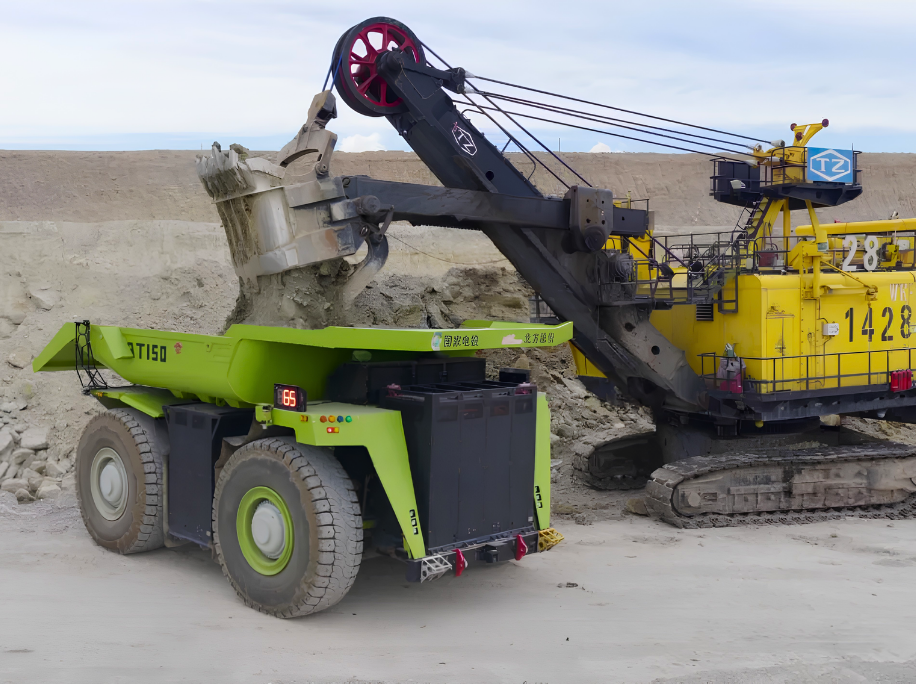
The AT150, however, can change its direction of travel without making a conventional turning movement. After entering a loading or dumping position in one direction, it can depart in the other.
This can simplify vehicle paths in loading and dumping areas, where space may be constrained and several trucks may be moving around the same excavator or dump point. Avoiding conventional switchbacks can reduce unnecessary manoeuvring and limit the number of paths that cross within the operating area, helping reduce congestion and streamline vehicle movements.
Bidirectional path planning also enables the system to determine how the truck should approach and leave each location, rather than relying on a fixed sequence designed around a conventional front-facing vehicle.
Using onboard perception data, the system creates an obstacle map of the loading or dumping area. It then dynamically searches for and optimises a suitable path and stopping position while accounting for surrounding obstacles, mine-road boundaries and the truck’s minimum turning radius.
At dumping areas, the system can also assess whether the assigned location remains available. If material has reached the permitted limit and the truck can no longer dump safely at that point, it can select another suitable position and continue operating.
These capabilities allow the autonomous system to plan around the mining task and the available space, rather than reproduce the movements required by a human-operated truck.
Perception and Control in Either Direction
Travelling at operating speed in either direction creates different requirements from conventional low-speed reversing. When the truck changes direction, the perception system at the newly leading end must provide the coverage and accuracy needed to identify road boundaries, obstacles and other vehicles. The autonomous system must then generate a new trajectory and make driving decisions based on that direction of travel.
EACON developed the AT150’s perception and planning capabilities around this bidirectional operating model, with sensor selection and placement tailored to the truck’s architecture and the requirements of bidirectional operation. Using perception data from both ends of the vehicle, the system generates smooth trajectories that keep the truck within the available driving area while accounting for its size and turning characteristics.
The system also supports traffic sequencing and task planning across fleets of bidirectional trucks. This allows vehicle movements to be coordinated at loading areas, dumping locations and other shared parts of the mine, rather than planning each truck’s path in isolation.
Reliable vehicle control is equally important. The AT150’s onboard main controller uses a safety-redundant architecture, with its hardware, software and algorithms designed to provide the computing capacity required for bidirectional autonomous operation in open-pit mining conditions.
Its control algorithms account for vehicle dynamics and continuously adjust steering, acceleration and braking. This helps the truck remain close to its planned path and maintain stable traction while avoiding abrupt steering, unnecessary acceleration and braking, or side-to-side “snaking” movements.
Together, these perception, planning and control capabilities turn bidirectional operation from a vehicle design concept into a fully integrated autonomous haulage capability.
Coordinating Charging with Production
The AT150's battery-electric platform also affects how the truck is scheduled and operated.
The vehicle platform can support static charging or battery swapping. At the current SPIC operation, the AT150 uses static charging. Its semi-solid-state battery is designed to operate across temperatures ranging from –30°C to 50°C, with its 900V battery system supporting charging at up to 3.4 MW.
For autonomous operations, charging can be considered alongside production tasks when work is allocated. Scheduling decisions can account for vehicle charge levels, task requirements, charger availability and wider fleet demand, incorporating charging into the production plan rather than managing it as a separate activity.
What the AT150 Could Mean for Mining
The AT150 is operating within a specific mine and production environment in China. Its longer-term performance will continue to be assessed through normal operations, and its application elsewhere would depend on each mine’s layout, infrastructure, regulations and operating requirements.
Nevertheless, the project provides a practical indication of where autonomous haulage may be heading.
The first phase of mining autonomy has largely focused on enabling existing trucks to operate without onboard drivers. Purpose-built vehicles such as the AT150 explore what can happen when equipment and mining processes are instead designed around the capabilities of autonomy from the outset.
Cabless architecture can remove constraints associated with accommodating an operator, while bidirectional travel can reduce conventional turning movements and allow loading and dumping layouts to be approached differently. To make this operating model work autonomously, perception and path planning dynamically determine where and how each truck should move, while fleet management coordinates vehicle tasks, traffic and charging requirements across the operation.
Elaine Jin, Chief Growth Officer at EACON Australia, said the project demonstrates how autonomy can influence the fundamental design and movement of mining equipment:
“The biggest shift is not removing the driver from the cab, but removing the assumption that mining equipment must be designed around a driver. When autonomy, electrification and vehicle architecture come together from day one, equipment can be designed around the mining task itself, enabling more efficient operations.”
For Australia and the wider global mining industry, the significance of the AT150 extends beyond the deployment of one new truck. By integrating bidirectional perception, path planning and vehicle control into a purpose-built platform, the AT150 offers a practical glimpse of mining equipment designed not around the direction a driver faces, but around the most effective way to complete the task.
Share this page